What’s on the menu for fish around Crete?
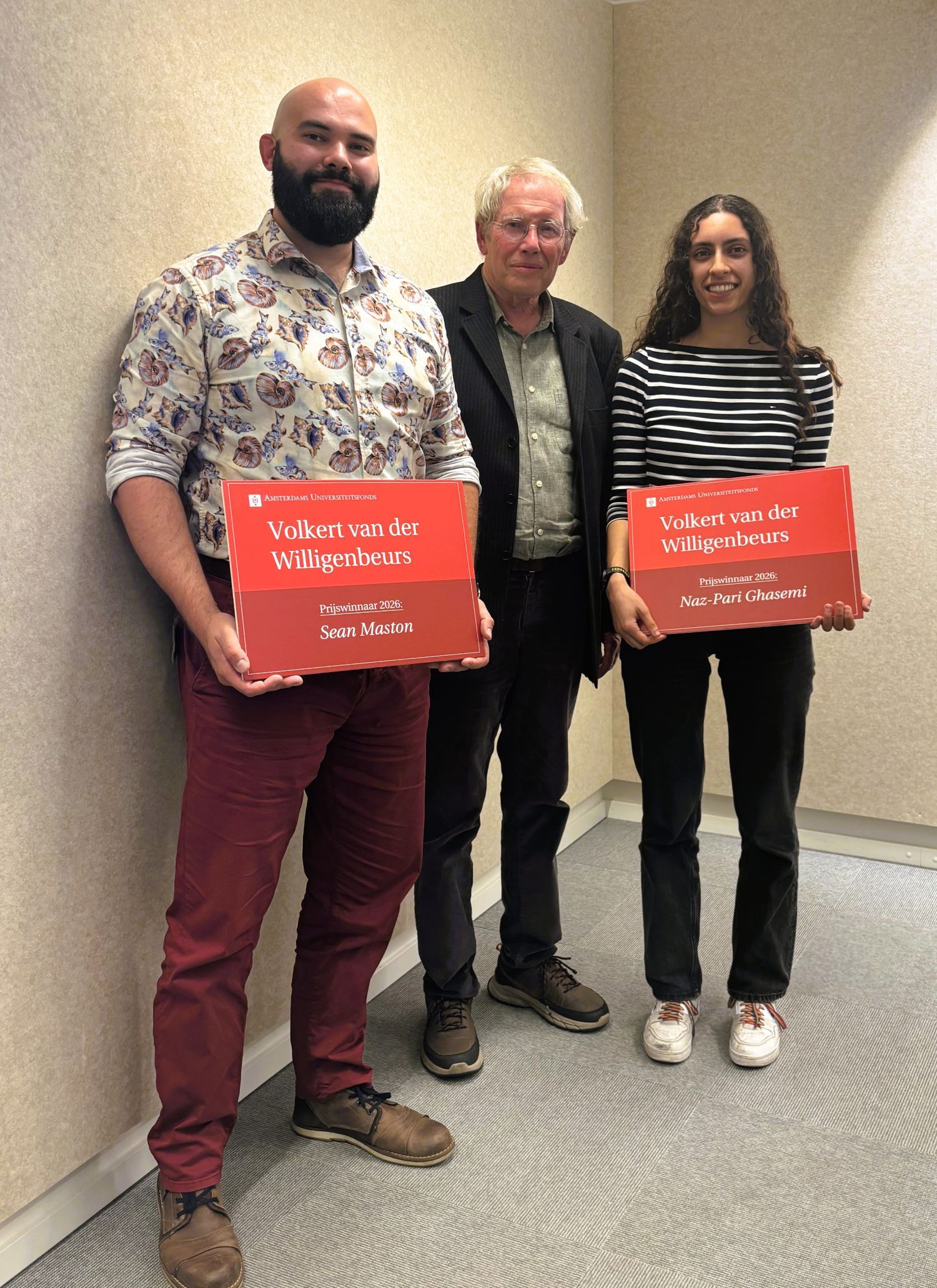
Volkert van der Willigen Award 2026
Beneath the waters around Crete, seagrass meadows teem with life and store carbon. But what happens when new plant and fish species arrive? UvA master’s student Sean Maston aims to find out through his research project Grazing on Change. In October 2026, he received the Volkert van der Willigen Award, which makes his fieldwork in Greece possible.
Maston grew up in the United States and studied botany at Oregon State University. ‘There, I investigated fungi that live in association with seagrass roots. Now in the second year of my master’s degree at the University of Amsterdam, I explore life underwater: from microorganisms and plankton to seagrass meadows.’
For Maston, the project also has a personal appeal. ‘This project brings together my two strongest interests: seagrass ecology and Greece.’
When the Suez Canal opened in 1869, it created a route for non-native seagrass and several herbivorous fish species to enter the Mediterranean
Seagrass meadows provide a habitat for a wide range of marine animals and store carbon. This makes them important for both biodiversity and the climate. But in the Mediterranean Sea, things are changing. Maston explains: ‘When the Suez Canal opened in 1869, it created a route for non-native seagrass and several herbivorous fish species to enter the Mediterranean from the Red Sea and the Indian Ocean. Many of these species have established populations and continue to spread. With climate change and warming waters, conditions in the Mediterranean are also becoming more favourable for some tropical species, potentially accelerating these ecological changes.’
How does their grazing affect seagrass growth?
Around Crete, Maston will compare seagrass meadows containing native species, non-native species and a mixture of both. Which herbivores live there? Which seagrass species do different fish prefer to eat? And how does their grazing affect seagrass growth, competition between species and carbon storage? ‘By linking herbivores and their feeding preferences to the growth and functioning of seagrass meadows, we can better understand how these changes affect the meadows.’
The approach
Maston will approach these questions in three steps. First, he will conduct visual surveys, observing and recording fish in different seagrass meadows to identify which herbivores are present. ‘Next, I will use underwater cameras to record which seagrasses the fish eat when offered a choice of seagrass species in a food-choice experiment and how their feeding preferences differ among species. Finally, I will monitor seagrass growth inside and outside protective enclosures that prevent grazing to investigate how grazing affects plant growth, sediment carbon storage, and the expansion of non-native species in the Mediterranean.’
This award makes the project possible and enables me to pursue this research as part of my master’s programme
Turning a research idea into a project on a Greek island also requires practical resources. Maston works at Albert Heijn alongside his studies, but cannot cover the costs of travel, accommodation and living expenses himself. The award makes all the difference.
‘This award makes the project possible and enables me to pursue this research as part of my master’s programme.’ In Crete, he will be able to study interactions between fish and seagrass directly in their natural environment.
The project will also strengthen collaboration and knowledge exchange between the UvA and the Hellenic Centre for Marine Research. ‘Through this work, I hope to contribute to understanding and protecting seagrass meadows, both in Greece and beyond,’ Maston adds.
Follow Maston on his personal website ( https://scmaston.wixsite.com/sean-maston ) where he will blog documenting the research process, fieldwork, and results of this work.
About the Volkert van der Willigen Fund
The Volkert van der Willigen Fund, administered by the UvA Fund, awards two grants each year to support scientific research in physics/astroparticle physics and biology/ecology.
Find out more or apply
To learn more about the Volkert van der Willigen Fund or how you can contribute, contact Juliette Nieuwland at j.m.m.nieuwland@uva.nl or call +31 6 29064648.
For information on how to apply, email subsidieaanvragen-AUF@uva.nl.