Physical activity as a key to protecting the brain in MS
Arianne Gravesteijn received her Startstipendium for research on MS
3 February 2026
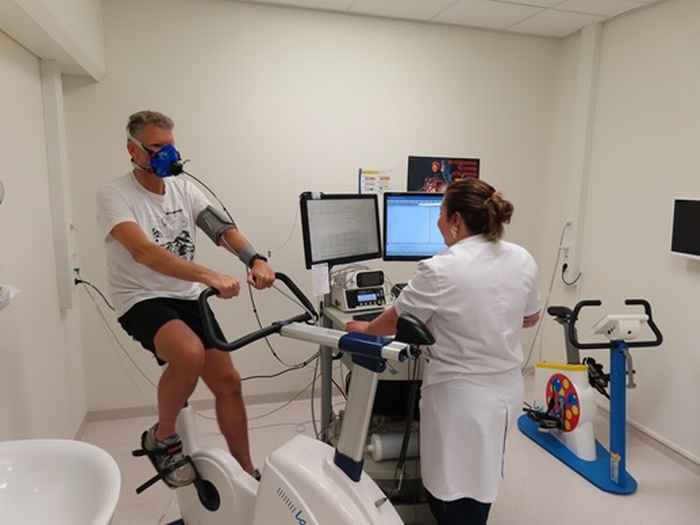
If Gravesteijn’s research is successful, clinicians and researchers will gain a better understanding of how physical activity can protect the brain in people with multiple sclerosis (MS). This may help to better understand disease progression and to use exercise therapy in a more targeted way as a complement to existing treatments. With support from the Startstipendium, Gravesteijn is investigating which biological processes underlie the beneficial effects of physical activity.
‘We already know that being physically active is good for people with MS, but we still don’t sufficiently understand why that is,’ says Gravesteijn. ‘By unravelling these underlying mechanisms, we hope to be able to explain how physical activity contributes to health and, more specifically, brain health.’
From human movement sciences to MS research
Gravesteijn works as a postdoctoral researcher in the Departments of Rehabilitation Medicine and Neurology at Amsterdam UMC and is affiliated with the MS Centre Amsterdam. In May 2025, she obtained her PhD with research into the role of physical fitness and physical training in disease progression in people with MS. She conducted this research within the Department of Rehabilitation Medicine at Amsterdam UMC.
Her academic path began with a Bachelor’s in Physiotherapy, followed by a Master’s in Human Movement Sciences with a specialisation in rehabilitation. ‘I find that combination very valuable,’ she explains. ‘I can link clinical questions from practice to fundamental and applied research. That helps me to conduct research that is truly relevant to patients.’
What does physical activity do in the MS brain?
In MS, many current treatments focus mainly on inhibiting inflammation. Yet neurodegeneration – the gradual loss of nerve cells – plays a major role in the development of permanent and progressively increasing disabilities. ‘That is precisely where an important problem lies,’ Gravesteijn explains. ‘We are becoming increasingly effective at treating inflammation, but protecting the brain remains a major challenge.’
Earlier studies show that physical activity can have positive effects on the brain, but exactly how this works is largely unknown. In her new project, Gravesteijn is investigating which substances are released through physical activity. ‘We are looking at so-called “exerkines”: substances in the blood that are influenced by physical activity and may have a protective effect on the brain.’
Using advanced serum proteomics, she analyses hundreds to thousands of proteins simultaneously. ‘By linking these molecular changes to brain imaging and clinical data, we can better understand which biological processes are associated with the beneficial effects of physical activity.’
Thanks to the Startstipendium: from movement to molecules
The Startstipendium makes this research possible. ‘These analyses are costly and often fall outside regular funding schemes,’ says Gravesteijn. ‘Thanks to the grant, I can apply high-resolution proteomics to existing cohort material.’
This not only yields new insights, but also helps her to build an independent line of research. ‘For an early-career researcher, being able to take these kinds of steps is incredibly important,’ she stresses. ‘The grant gives me the freedom to ask innovative questions and to use new methods.’
Towards personalised physical training
With her research, Gravesteijn hopes to identify biological markers that explain how physical training can influence the brain. ‘Ultimately, this could lead to simple, affordable biomarkers to monitor disease progression and the effects of physical training.’
The impact of the Startstipendium is significant in this regard. ‘It helps to bridge the gap between what we observe in people who are physically active and what is happening at the molecular level in the body,’ says Gravesteijn. ‘That link is essential if we are to use physical training as a serious, biologically grounded intervention.’
Her ambition is clear: ‘If we can better understand how physical activity protects the brain, we can provide more targeted support to people with MS. Even small steps towards slowing disease progression can make a big difference to quality of life.’

If we can better understand how physical activity protects the brain, we can provide more targeted support to people with MS. Even small steps towards slowing disease progression can make a big difference to quality of life
The Startstipendium of the UvA Fund
With the Startstipendium, the UvA Fund supports promising young medical researchers. Candidates for the Startstipendium are employed by Amsterdam UMC or Amsterdam UMC Research BV, are affiliated with one of the eight research institutes of Amsterdam UMC, and obtained their PhD no more than five years ago. The next application round is scheduled for spring 2026.
Contributing to the Spinoza Fund
The Spinoza Fund (which makes the support of the Startstipendium possible) supports young academic talent. Anyone can contribute to this fund. For donations and more information, please visit the website or contact Juliëtte Nieuwland: j.m.m.nieuwland@uva.nl.