‘I hope our findings contribute to better therapies for people with Alzheimer's disease’
10 March 2026
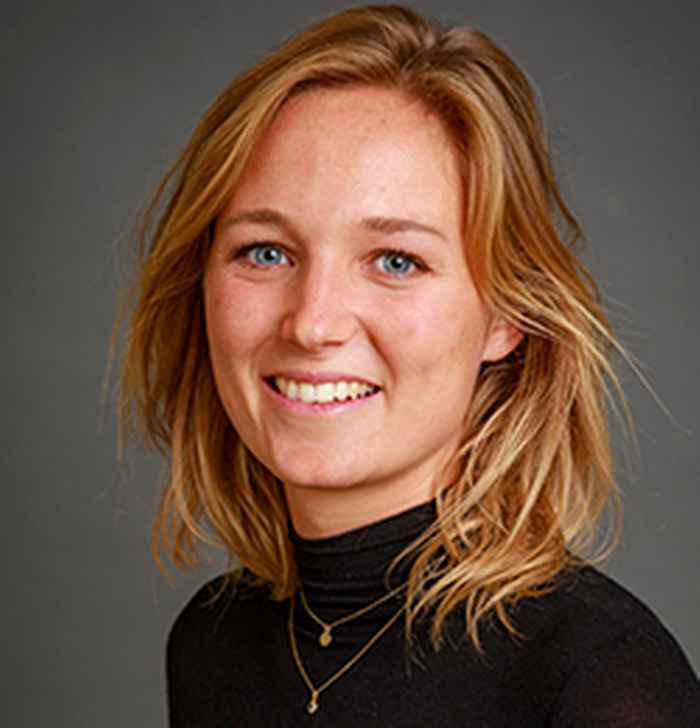
If Van Nifterick research succeeds, doctors will have a much clearer picture of which brain cells go ‘off the rails’ in Alzheimer’s disease and which molecular processes drive this. This could pave the way for more targeted treatments, such as safe forms of brain stimulation, which may slow the disease, delay symptoms or even reduce them.
‘By understanding where things go wrong in the brain, we can start to see how we might intervene,’ says Van Nifterick. ‘Ultimately, I hope our findings will contribute to better therapies for people with Alzheimer’s.’
From Amsterdam to the Alzheimer Centre
Van Nifterick is 31 and a true Amsterdammer. ‘I was born and raised in Amsterdam and stayed here to study,’ she explains. After completing a Bachelor’s in Health and Life Sciences at Vrije Universiteit Amsterdam (VU), she went on to do a Master’s in Neurosciences. She obtained her PhD at VU in early 2025 and now works as a postdoctoral researcher at Alzheimercentrum Amsterdam, part of Amsterdam UMC, VUmc location.
‘I’ve always wanted to understand how the brain works,’ she says. ‘Alzheimer’s has always fascinated me: what goes wrong, and how does the disease develop? At the same time, I saw what it does to people – how they lose their memories and independence. That has a huge impact on patients and their loved ones. That’s what motivates me to work on this particular disease.’
What Goes Wrong in the Alzheimer’s Brain?
In her research, Van Nifterick focuses on the electrical activity of the brain. ‘You can measure brain activity using techniques such as EEG and MEG,’ she explains. ‘These are safe, painless recordings of brain waves – a bit like an ECG “heart tracing”, but for the brain.’
For a long time, we thought that’s because brain cells are dying. But we see these changes very early on, even before there is clear brain shrinkage. That’s an important signal that something else is going on.
Two things stand out in people with Alzheimer’s: their brain waves slow down, and the connections between important hubs in the brain network become weaker. ‘For a long time, we thought: that’s because brain cells are dying,’ says Van Nifterick. ‘But we see these changes very early on, even before there is clear brain shrinkage. That’s an important signal that something else is going on.’
More and more research suggests that certain brain cells are actually overactive. ‘We think that increased excitability of brain cells – cells that “fire” too easily – plays a role,’ Van Nifterick says. ‘If that’s true, it opens up new possibilities for intervention.’
Thanks to the Startstipendium: From Brain Waves to Brain Cells
To investigate this, Van Nifterick combines brain wave measurements with research on donated brain tissue from people with Alzheimer’s. ‘We study the brains of people who, during their lifetime, underwent EEG or MEG testing at the Alzheimer Centre,’ she explains. ‘We specifically select people in whom we observed epileptic activity. That’s the clearest form of excessive excitability.’
The Startstipendium makes a crucial step possible. ‘Thanks to this funding, we can determine for each cell which genes are switched “on”,’ says Van Nifterick. ‘Using single-nucleus RNA sequencing – an advanced technique – we obtain a kind of molecular “fingerprint” for each cell. That allows us to find out which cells are more sensitive to stimulation than you would expect and which molecular switches are involved.’
Towards Better Treatments
With this knowledge, Van Nifterick hopes to identify starting points for treatment. ‘If we know which processes and cell types contribute to that increased excitability, we can think more specifically about how to restore the balance,’ she says. ‘For example, using non-invasive brain stimulation, where we gently modulate brain activity from outside the skull.’
The role of the Startstipendium is indispensable in this. ‘Without this support, we simply couldn’t carry out these expensive, detailed analyses,’ she emphasises. ‘The grant gives us the opportunity to bridge the gap between what we see in brain recordings and what goes wrong at the cellular level.’
Her goal is clear: ‘I hope that in the end we can help develop treatments that slow the disease down or reduce symptoms,’ says Van Nifterick. ‘For people with Alzheimer’s and their loved ones, even a small delay in decline would make a world of difference.’